
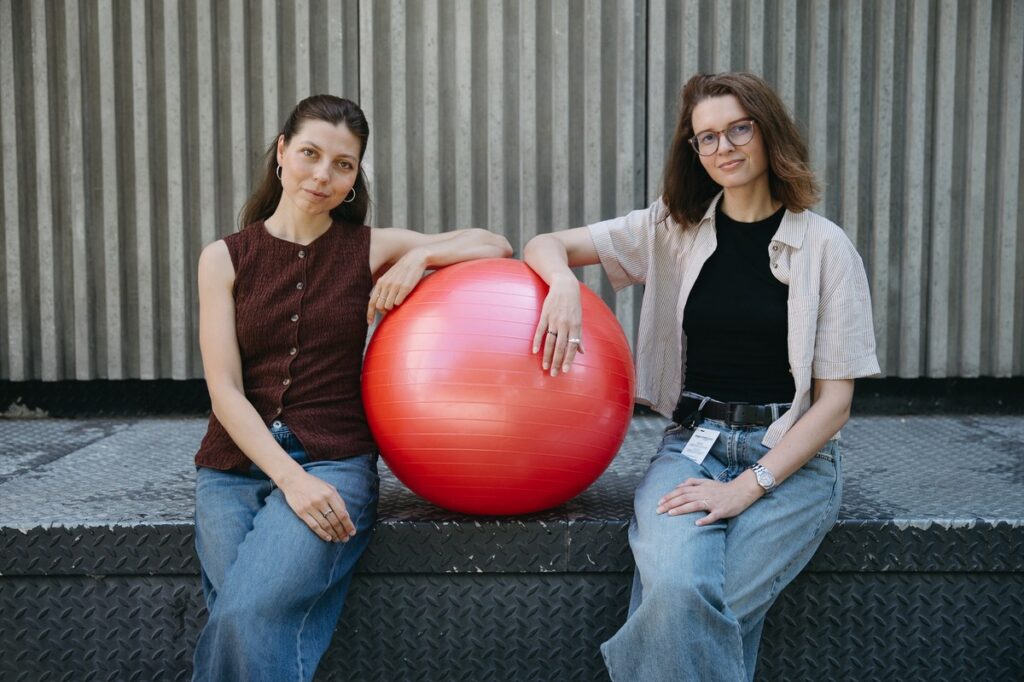
The short live-action film This Room is Impossible to Eat directed by Emília Ondriašová — a sensitive adaptation of the eponymous novella by writer Nikol Holzerová about a growing-up Tereza and about what a child cannot name — is part of the Shorts II block in the International Short Film Competition of the 32nd IFF Art Film Košice. The film, shot on 35 mm film stock, was made as a graduation project at the Academy of Performing Arts (VŠMU) in Bratislava. Both festival screenings — on Saturday 20 June at 16.30 and on Monday 22 June at 10.30 — were accompanied by an introduction and a discussion in the presence of director Emília Ondriašová and producer Marianna Vadovičová.
For director Emília Ondriašová, the choice of the literary source was deliberate. “At school I started flirting with the idea of choosing themes for my films not only from my personal life, which is the classic approach in school. I read a lot, I love Slovak and Czech authors. When I read Nikol Holzerová’s book This Room is Impossible to Eat, I said to myself that this is one of those small books that deserve to come to light also in film form,” Ondriašová said. It is not her first adaptation — previously, as a school exercise, she adapted the short story Prázdniny from Dušo Martinčok’s collection Niekto sa nájde, which in the form of her short film Tento divný deň premiered in Kraków.
Holzerová’s novella is written from the perspective of the heroine in three age periods — at 12, 15 and 18. Ondriašováchose a different approach in the short film, but kept the child and teen perspective. “It is essential, because you can see how the perception of the same situation changes when one is twelve, fifteen and eighteen. Really, it is not the same. The child does not look at the older man in the same way at twelve as at eighteen. That’s probably why Nikol chose this approach,” the director explained.
The film builds on visual metaphors borrowed directly from the book. “Many of them we could simply take and transfer to the screen — and they have enormous power. Nikol manages to create a feeling of unease, longing or imprisonment not through descriptive narration but precisely through those metaphors, which evoke the emotion in us more strongly than if she had described it directly,” the director said. One of the strongest scenes is the plaster in the heroine’s mouth — and in this case it was real plaster, not a prop. With set designer Natália Mináriková, Ondriašová spent a long time working on it: “Someone made a wall, but it didn’t look good. Fortunately we had a real set — and that’s what ended up in the final cut. Yes, she had real plaster in her mouth. But we had water and basins ready, where she could spit it out. She did it,” Ondriašová revealed.
She approached the delicate topic aware of certain risks. “With every film one fears what will come out of it. But I knew that the material was extremely good — and so was the casting. Viktória Šuplatová, who played fifteen-year-old Tereza, and Ady Hajdu, who played the teacher, have known each other for many years. Ady, as he says, used to push her in the pram when she was little. It was a little odd for her, but partly thanks to that a safe space was created on set — we had close relationships and supported each other,” she said. From today’s perspective, however, she would do some things differently: “A project like this would require consultation with a psychologist, perhaps a child or teen psychologist, and there should be an intimacy coordinator on set. In our case this was not possible — but it certainly should not be done without them,” Ondriašová added.
The path of literary adaptation Ondriašová wants to keep pursuing. “I don’t need to explore this particular topic any further at the moment — once one has dealt with it, one wants to leave it alone for a while. But I definitely plan to keep adapting literature. There are plenty of excellent Slovak and Czech authors who deserve to be discovered in film adaptations,” said the director, who admitted that her next title is already “in her sights”.
Producer Marianna Vadovičová sums up the making of the film as one of her best school collaborations. “The film came about as an exercise at VŠMU and we absolutely did not expect that such a beautiful film would come out of it. It is beautiful in its simplicity,” she said. For her, the director was decisive in the choice of material. “Emília Ondriašová convinced me — I saw her passion for this literary source from the first second. I trusted her that it would be a good theme and that it would all turn out well. It was the best collaboration at school — every author lived for that project,”Vadovičová added.
The choice of 35 mm film stock was, according to Vadovičová, partly given by the exercise itself, partly by a dramaturgical decision. “It was part of the exercise and at the same time a directorial-producing decision. In some way we paired the theme with that material — we knew this would be a good subject to work on within the constraints we had. We struggled a bit with the number of roles and with the length of the exercise, which should have been shorter than it ended up being, but I think it turned out well in the end,” said the producer. About the overall accessibility of short film she added: “Since the Slovak Audiovisual Fund opened a call also for short films, many more are being made — and I hope we will see even more of them in cinemas.”
The role of the producer in a film with a sensitive topic Vadovičová sees as the guarantor of a safe space. “The role of the producer is to make sure everyone in that process feels safe — both creators and actors. And since the film was made from a literary source, we tried in some way to consult with the author of the novella herself.” They were in touch with Nikol Holzerová, but the author has not yet commented on the finished film. “I hope, then, that she doesn’t think badly of it,” Vadovičová added with a smile.
The collaboration with Ondriašová continues. “We have a feature film in development, written by screenwriter Adrián Bihári — we also met at school — and Emília will direct it. Plus one more short film with Adrián Bihári and several other titles at an earlier stage,” Marianna Vadovičová revealed.
The winner of the International Short Film Competition of the 32nd IFF Art Film will be decided by an international three-member jury (Maciej Gil from Poland, Mohammed Almughanni from Palestine and Barbora Sliepková from Slovakia); the winning film will receive the Blue Angel statuette. The complete festival programme (19 – 25 June 2026) can be found at aff.cinepass.sk.
The 32nd IFF ART FILM is being held with the support of:
Main organizer: ART FILM FEST s.r.o.
Co-organizers: City of Košice, K13 – Košice Cultural Centres, Visit Košice, ART FILM FEST, n.o.
With the financial support of: the Slovak Audiovisual Fund
The project was co-financed by the Košice Self-governing Region from the Terra Incognita program
Main partners: CODES Brand House, H2O FUND SICAV, Fors – stav
Automotive partner: AUTO-VALAS
Official hotel: Hotel Yasmin
Main media partners: TV JOJ, Pravda, Eurotelevízia
Sponsors: U. S. Steel Košice, ANTIK Telecom, Kino Úsmev, LOKO TRANS Media, CORE Labs, Technical University of Košice
Technological partners: NOV, ZEBRA, Deutsche Telekom Systems Solutions Slovakia, DELTA OnLine, ARICOMA, Datacomp
Official suppliers: DKC Veritas, PLOOM, DOMOS SLOVAKIA, Reštaurácia Contessa, Natura, Kinley, Budweiser Budvar, Julius Meinl
Official wine: KubBo Select, Ostrožovič
Media partners: JOJ play, JOJ 24, Film Europe Media Company, Rádio KOŠICE, Aktuality.sk, Forbes, Startitup.sk, Korzár, Slovenka, SITA, TASR, Mediaboard, AHOJ TV, See & Go, BigMedia, Kino Sterio, Košice City Guide, Košice V Skratke, MOJAkultura.sk, Česko-Slovenská filmová databáze – ČSFD, Filmsk.sk, diva.sk, koktejl.sk, zenskyweb.sk, Naše Košice
Partners: JOJ Cinema, Jojko, Slovak Film Institute, WITKOWITZ SLOVAKIA, DDDental, CK TUI ReiseCenter Slovensko, Wallonie-Bruxelles International.be, Taper, ECO Technologies, Aupark Shopping Center Košice, Košice Public Transport Company, Košice Airport, YumEarth, Rent2Eat, CPK Transport, iWish.sk, Kvety Garomi, Hair Factory Košice, Face up! Studio by Michaela Petroci, Panta Rhei, ARTFORUM, LOCAL NOMAD, East-Slovak Museum in Košice, MIHYRING