
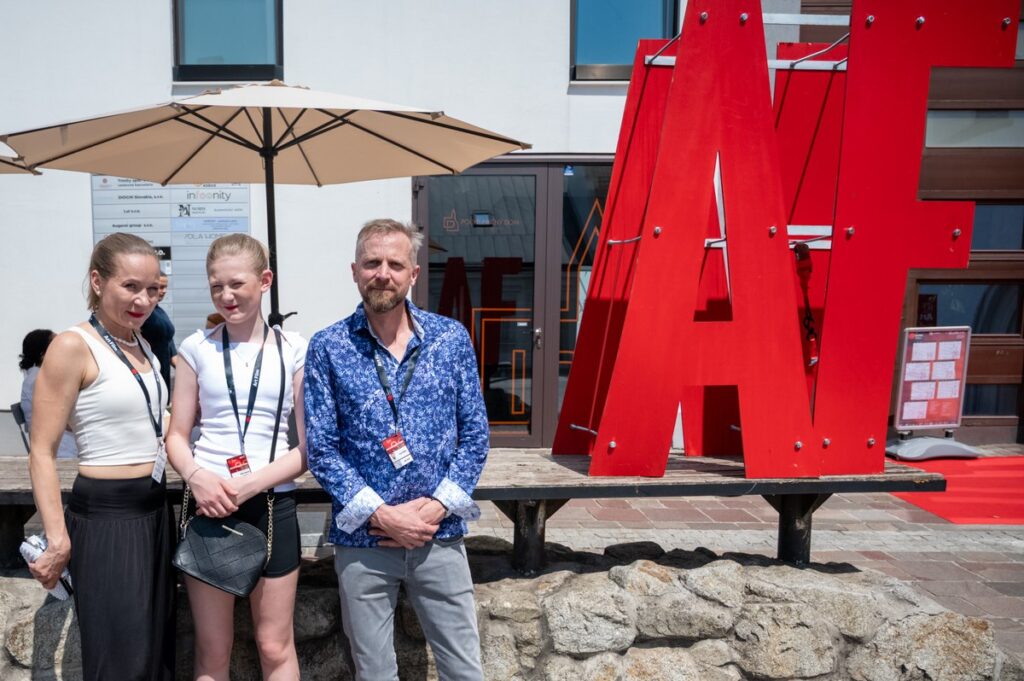
In the Slovak Season section of the 32nd IFF Art Film Košice, the sixty-minute documentary Everest: A Mother’s Peak, directed by Scottish documentarian Paul Diffley, was screened on Saturday, 20 June 2026 at Kino Úsmev and on Sunday, 21 June at Kino Veritas. The film captures the climb of scientist, mountaineer and mother Lucia Janičová — the first Slovak woman on the summit of Mount Everest — interwoven with a personal story about childhood, motherhood and how pain can be turned into strength. Both screenings were accompanied by an introduction and a discussion with the filmmakers in the presence of director Paul Diffley, Lucia Janičová and her daughter Adela Janičová, who is also a protagonist of the film. Both screenings were followed by an AF INDUSTRY masterclass Documentary Challenge – A Journey with a Camera to Mount Everest on Sunday, 21 June at 13.00 at Kulturpark Galéria ALFA.
For Lucia Janičová, the film was not just a record of a first ascent. “The film was not made to tell another story about Everest, but to inspire others who also have difficult life situations behind them. I wanted to give them courage and show that even pain can be turned into strength, that any small step can take us to great goals, and that we don’t have to be victims of our past but the authors of our future,” said Lucia Janičová.
The title of the film Everest: A Mother’s Peak reflects Janičová’s personal view of motherhood: “Growing up, I didn’t see many women mountaineers around me. I saw strong women — my mother, my aunts, my grandmothers — who held the families together while the men went off for adventure. I always perceived a mother as someone who sacrifices her life. Over time I realised that it shouldn’t be like that: we, parents, are models and role models for our children. And when we show them that we are brave, that we believe in ourselves and that we are not afraid to set out for high goals, that is what we can pass on to the next generation. It was very important to me — I did it for my own daughter,” she explained.
Janičová’s climb was not built only on physical preparation. As a scientist she also approached it professionally: “I admit, without science I would not have been able to climb Everest. For me, science is part of the climb. I spent over a year studying physiology in extreme conditions because I needed to understand how my body works in such an environment — and based on that I planned my climbing tactics,” she explained.
The symbolic meaning of the climb went beyond sport for Janičová. “Forty years ago the first Slovaks — Zoltán Demján and Jozef Psotka — stood on the summit, but no Slovak woman had ever done it. Everest came to me as a symbol of the gap between men and women, which I decided to fill. I was inspired by Frešta Ibrahimi, an Afghan refugee with a difficult past and the same kind of huge dream. I wanted to tell women that we will never know what we can do until we try,” said Lucia Janičová.
The most demanding part of filming, according to Janičová, was capturing herself. “It is easier to film someone else, but there wasn’t always someone beside me. At certain moments I had to weigh up whether I would let my hands freeze or whether I would have the shot. That was the trade-off: I’ll have the footage, or I won’t,” she described.
For viewers who have never climbed, the film carries a simple call: set your own Everest. “Everest is not just one. Our dreams don’t have to be mountaineering — for some people, Everest is also a kilometre on foot or five kilometres at a run. The important thing is to set a higher goal, something we have a relationship with. Step by step, let us not look how far we still have to go, but how far we have already come,” Janičová summed up.
Director Paul Diffley, a Scottish documentarian who specialises in films about climbing and adventure and Janičová’slife partner, came to the project naturally through their shared trips to the mountains. “I never imagined making a film about her — she’s not a professional athlete, she’s a scientist. But when we discovered that no Slovakian woman had ever climbed Everest, I could see that this was a national first that could actually work,” said Diffley. Part of the climb in the Himalayas was filmed by Nepali cameraman Manish; the rest was shot by Lucia herself and her Sherpa — alongside GoPro cameras, many scenes were filmed on the iPhone 15. “It’s shocking how good it is. When I started filmmaking, I couldn’t imagine that people would ever use a mobile phone to shoot footage,” Diffley added.
Diffley’s approach was new for him too — the subject of the film was his long-term partner and post-production took 18 months. “Whereas in the past I would film the climbers, lock myself in a room for three months and the first time you would see the film would be at the premiere, this has been a much more collaborative process with Lucia. I think the result is a better film,” he explained. For the director, the high point of the narrative is the chapter about Janičová’schildhood in Slovakia, which is further shaped by animation. “My favourite part is where we learn about Lucia’s home life and growing up in Slovakia — for me, that’s the turning point of the film. The animation also let me take a more creative approach: I didn’t want it to be a very straight BBC-style documentary, talking heads and clips,” said Diffley.
The third layer of the film — the perspective of the family staying at home — is represented by Lucia’s daughter Adela Janičová, who in the film plays both herself and her mother as a young girl. “I really enjoyed playing my mum when she was little. I liked playing both my mum and myself,” said Adela. She understands her mother’s climb, yet also admits her fear: “I was afraid for her — I didn’t know whether she would come back. But I knew she would do it. I was a hundred percent proud of her, and I told her so,” she added. She also worked her mother’s story into a short book for readers aged 6 to 8: “It’s called Moja mama vyliezla Everest (My Mum Climbed Everest). It’s not long, but I think it’s good,” Adelasaid with a smile. The Košice festival was wonderful for her, although she had to get used to it: “I was afraid when I had to stand in front of maybe three hundred people. I’m not used to it at all, but my mum already is,” she added.
As part of the AF INDUSTRY accompanying programme, Lucia Janičová and Paul Diffley opened on Sunday, 21 June at 13.00 at Kulturpark Galéria ALFA the masterclass Documentary Challenge – A Journey with a Camera to Mount Everest. The hour-long discussion for film professionals was devoted to the practical challenges of filming in extreme conditions — from planning and financing an international coproduction, through working with amateur and professional equipment (GoPro, iPhone 15), to the dramaturgical construction of a personal documentary story. For Diffley, story is what matters most: “Not everyone in the world is interested in mountaineering, but everyone is a person, has parents, has children — and can relate to these stories. Focusing on the human side is what makes the film universal,” he explained.
Lucia Janičová is already preparing her next expedition: she wants to complete the so-called Seven Summits — the highest peaks of all continents — and besides that she has another project on the table, which she is not yet talking about publicly. The film Everest: A Mother’s Peak continues after the Košice festival to other international festivals and the producers are currently negotiating the sale of distribution rights.
The complete programme of the 32nd IFF Art Film Košice (19 – 25 June 2026), including the Slovak Season section and the AF INDUSTRY programme, can be found at aff.cinepass.sk.
The 32nd IFF ART FILM is being held with the support of:
Main organizer: ART FILM FEST s.r.o.
Co-organizers: City of Košice, K13 – Košice Cultural Centres, Visit Košice, ART FILM FEST, n.o.
With the financial support of: the Slovak Audiovisual Fund
The project was co-financed by the Košice Self-governing Region from the Terra Incognita program
Main partners: CODES Brand House, H2O FUND SICAV, Forstav
Automotive partner: AUTO-VALAS
Official hotel: Hotel Yasmin
Main media partners: TV JOJ, Pravda, Eurotelevízia
Sponsors: U. S. Steel Košice, ANTIK Telecom, Kino Úsmev, LOKO TRANS Media, CORE Labs, Technical University of Košice
Technological partners: NOV, ZEBRA, Deutsche Telekom Systems Solutions Slovakia, DELTA OnLine, ARICOMA, Datacomp
Official suppliers: DKC Veritas, PLOOM, DOMOS SLOVAKIA, Reštaurácia Contessa, Natura, Kinley, Budweiser Budvar, Julius Meinl
Official wine: KubBo Select, Ostrožovič
Media partners: JOJ play, JOJ 24, Film Europe Media Company, Rádio KOŠICE, Aktuality.sk, Forbes, Startitup.sk, Korzár, Slovenka, SITA, TASR, Mediaboard, AHOJ TV, See & Go, BigMedia, Kino Sterio, Košice City Guide, Košice V Skratke, MOJAkultura.sk, Česko-Slovenská filmová databáze – ČSFD, Filmsk.sk, diva.sk, koktejl.sk, zenskyweb.sk, Naše Košice
Partners: JOJ Cinema, Jojko, Slovak Film Institute, WITKOWITZ SLOVAKIA, DDDental, CK TUI ReiseCenter Slovensko, Taper, ECO Technologies, Aupark Shopping Center Košice, Košice Public Transport Company, Košice Airport, YumEarth, Rent2Eat, CPK Transport, iWish.sk, Kvety Garomi, Hair Factory Košice, Face up! Studio by Michaela Petroci, Panta Rhei, ARTFORUM, LOCAL NOMAD, East-Slovak Museum in Košice, MIHYRING